The EMO P&L
The hidden costs in making a book, a story, or a basketball team

Last week I read an article in Fast Company about Google DeepMind CEO Demis Hassabis’s AI predictions. Rowan Cheung conducted the interview for The Rundown AI newsletter.
The headline grabbed me. Google DeepMind CEO on the skills humans need in the AGI era. In the article, he says, “In the next five years, those with ‘taste, design sensibility, original thinking’ and the ability ‘to synthesize different subjects together’ will be in an amazing position.”
That’s good news for some of us.
There is a concept I use in my professional and personal work. I call it the Emotional P&L. That might sound woo-woo or idealistic, but ignoring it as a blind spot can end up costing you. It needs a better name. Maybe The Emo P&L? What does that mean? In music, Emo is short for emotional hardcore—bands like Sunny Day Real Estate or My Chemical Romance. Honestly, I don’t know a thing about these bands! Maybe they sound like The Pixies.

The Pixies, in the past, if you know the photo credit-let me know.
I think the Emo P&L is exactly the type of work that Hassabis is talking about.
This is an important skill because the emotional P&L is one thing AI can’t seem to master. It falls into “synthesizing different subjects together.” In this case, it’s cost, market perception, or even ethics and that hard-to-pin-down variable: feelings.
Let me give you a publishing example.
What if you are printing a book at a vendor that doesn’t have the best price, but your production manager has a great relationship with them? Maybe the work is costing you an extra $0.50 or so per unit. Let’s say over 10,000 units, that equals $5,000—nothing to sneeze at, for sure. If you print the book year after year, it certainly adds up.
But what if you have a sudden uptick in sales? Your manager has the relationship with this vendor to ask for an expedited turn. With a new vendor, you might be a face in the crowd and lose months of revenue because you are out of stock. Or perhaps this vendor grants you better payment terms? That can be a game changer for cash flow. I’m not saying which is the right answer, but I am saying it’s worth noting.
America recently celebrated its 250th birthday. This reminds me of a great example of the Emo P&L. Here’s a bold statement: “You can’t make a USA 250th Anniversary coffee table book and print it in China!” Maybe people don’t care. Maybe they just want the lower MSRP. Maybe you charge what you would for any product and take the ding on margin? Here’s the question: What would your marketing director tell you? If Walmart is going to sell it, do you think their marketing team wants to risk patriotic egg on their face?

Advert from the web, notice where the item was made? They even add an exclamation point.
How about this? You have an editorial budget for a book. Your author prefers to use a certain editor. The P&L only allows $7,000 for editorial, but the chosen editor is $12,500. What if you go hard-nosed on this and make the author choose? To be sure, in big-name cases, it’s not even a conversation. This is because the publisher has thought about the Emo P&L, whether they realized it or not. You want your star author to have buy-in on the project. Making sure they have their trusted companion for the work is crucial. You might have to look elsewhere in the budget to pay for these changes, but it might be worth it. It’s totally worth it.
My wife and I watch a BBC cop show called “Pie in the Sky.” There was an episode, “Breaking Bread,” in which the police chief tried to replace the cafeteria’s cook with a vending machine and a microwave. You can see where this is going, right? The idea was that there would be lower costs with no impact. Win-win. Not so fast. First off, the team did not like the change or the microwaved food. But here is the Emo P&L at work. Eventually, the chief—after much gnashing of teeth—asks Crabbe, our main character who also owns a restaurant, for his take. I’m going off memory here, but this is the upshot:
“Where do you think most cases are solved?”
“Why in the cafeteria of course!”
“Why”
”Because people from different groups get together, discuss their work, and make connections.”
Sure, this is a TV show and maybe they don’t tell you this at Harvard Business School, but how much money would really be saved by using a microwave if the solve rate suffered as a result?
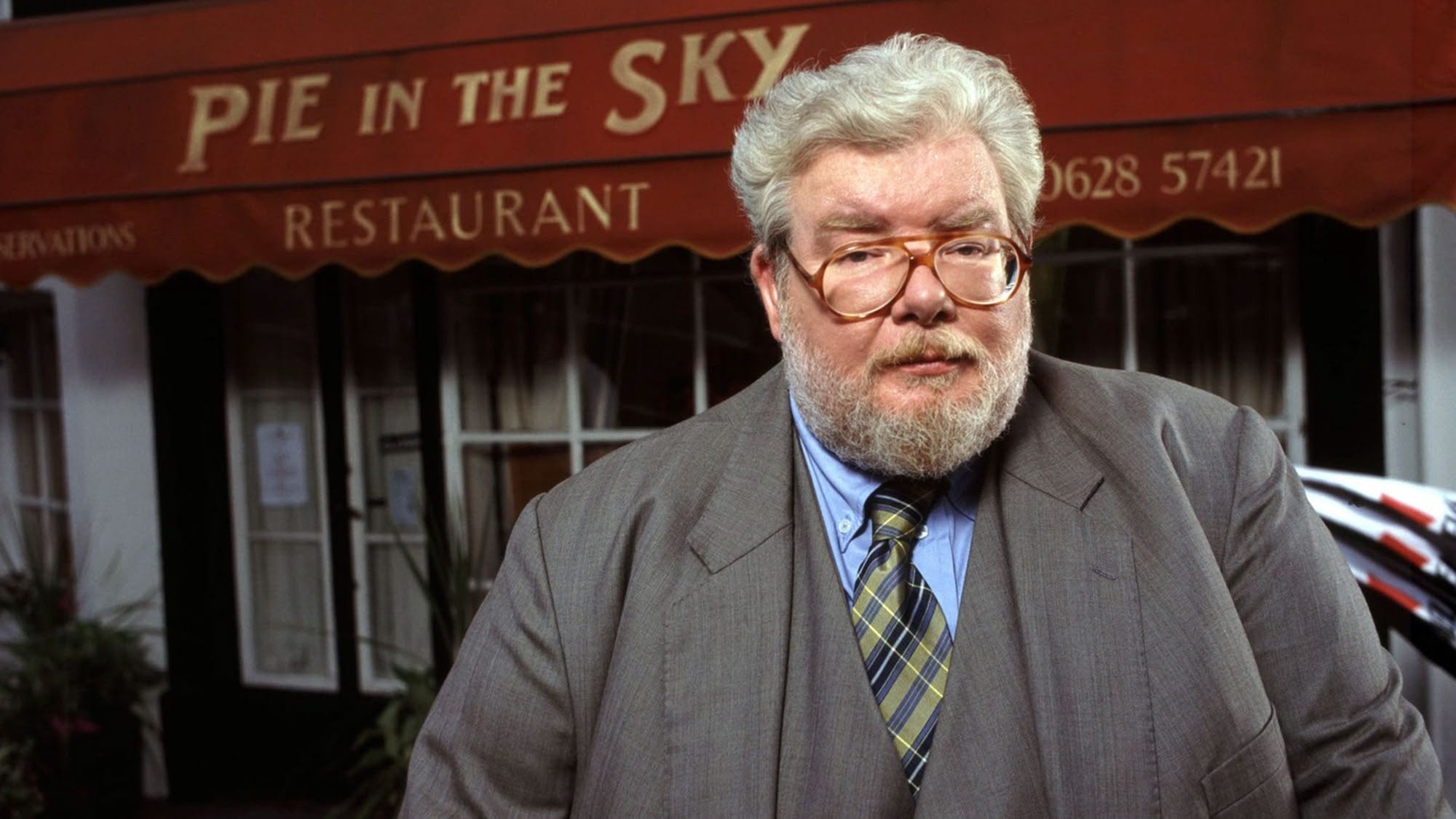
Detective Crabbe from SkyTV
Here’s another example. I was in a meeting once where a finance leader, summing things up, wanted to leave us with an object lesson. At Chick-fil-A, there was an employee who gave away 2–3 packets of sauce to everyone with their order. He was there for 30 years. He knew every He was beloved, and he doted on his customers.
Well, someone at Chick-fil-A ran the numbers and realized that at $0.05–$0.08 per packet over 30 years, he had given away a million dollars’ worth of sauce.
Naive me, I thought the tale was leading to, “Remember, it’s the customers we impact; it’s the people who make the business!” Because my first reaction was, How much money did this employee generate in revenue for CFA because people felt special, they came back over and over!
But no, that wasn’t it. The lesson was about the money lost.
They are 100% right! It’s a lot of money. However, if you Google this topic, there are CFA brand loyalists Reddit threads upset that Chick-fil-A has a strict one-package-per-order rule in place now. Some say the emotional toll is worse than gas prices!
You could argue that people will bellyache, still come for the food, get over it, and in a few years no one will know, and you will have millions saved. In this case, I would side on the one packet call. It’s substantial impact and if you want more, you can ask. In most cases it sounds like they will comply.
How about the basketball business? It’s long been a mainstay of the Emo P&L, but things are changing. The Luka Doncic trade and the Jaylen Brown trade both come to mind. Both happened in the last two seasons, and both were head-scratchers.
Luka was a beloved star in Dallas playing for the Mavericks, the appointed heir to Dirk Nowitzki’s throne. He took the team to the Finals in 2024, which used to mean something to a franchise. Then, the following February, he was traded for almost nothing in the middle of the night.
The deal made very little basketball sense, but what was clear was that the Mavericks wanted “out of the Luka business.” I love this phrase that is used in basketball talk: “So-and-so team wanted out of the so-and-so business.” To add clarity, the “Luka business” is a once-in-a-lifetime offensive player who struggles with staying in shape and can be mercurial. His offensive stats alone say you’d be mad to let him go, but apparently not—especially against the money (projected five-year, $345 million supermax contract extension) that the Mavericks owed him.
The basketball P&L is weighted for emotions. But now it’s at war with the basketball business P&L.
Jaylen Brown—oh, what a tangled web. He’s the Robin who thinks he was Batman; maybe he is Batman! For the Boston Celtics lore, Jayson Tatum is Batman. In the previous season, Tatum gets hurt with a season-ending Achilles injury. Despite that, Jaylen Brown still takes the Celtics to 50-plus wins and the Finals. But now the plot twist: Tatum returns for the finals, the C’s lose to the Knicks, and the Knicks go on to win the championship. Fast forward to within 18 days of the season ending: the Boston Celtics trade him to a fierce rival, the Philadelphia 76ers, for a lesser player.
One theory is that Brown was no longer happy and would not go back to being Tatum’s second fiddle. Another theory involves the second apron and the Celtics now being owned by a private equity firm. Luka and Brown are both potentially examples of cost-leading basketball decisions.
It’s worth noting that recent NBA financial rules force teams to make these decisions. Does this make the sport better and more equal? Does it protect teams from getting into bad deals they cannot support long-term? The summary is this: team owners are making salary decisions vs. basketball decisions. At the same time, we live in an era where there is no shortage of data to add to the decision-making process—to fill out the P&L.

Photo by author from West Tennessee Public Court.
I’m not remotely a basketball expert. But let me tell you this: I grew up watching the sport. I saw Dr. J on TV. I saw Larry Bird play a preseason game. I watched the Dream Team on TV. I saw Allen Iverson in Philly. I saw Dirk Nowitzki in Memphis. I was at a bar in Fort Pierce when LeBron made “The Decision.” I read The Ringer and ESPN, and I listen to the Bill Simmons show. There are probably sports junkies who make fun of Gen X guys like me who listen to Bill Simmons.
But what is clear is that there are big-time business decisions that you cannot see in the box score.
In the NBA, you have the basic stats: points, rebounds, assists, blocks, steals, turnovers, and minutes played. These are all easily quantifiable. You can dig a little deeper with field goal percentage. If your star makes 33 points a game but does it on 28% shooting, that means he hoisted up a lot of clunkers. You can apply this to three-pointers, free throws, and field goals.
Then you have advanced metrics. Advanced metrics were made possible by optical motion-tracking cameras and increased computing power. Also, baseball sabermetrics influenced this. Basketball, with these new tools, became even more of a data science—for example, the three-point shot with Steph Curry as its most notable user.
The case for taking more 3-point shots was rooted in math. If a team made 50% of their shots inside the 3-point line, they’d score 100 points if they took 100 shots. If a team made 34% of their 3-point shots, they’d score 102 points on 100 three-point shots. -from Underarmor
Here are some advanced metrics: True Shooting Percentage, Effective Field Goal Percentage, Player Efficiency Rating, Box Plus/Minus, and Net Rating.
Let’s look at Net Rating; it’s defined as the difference in team points scored and allowed per 100 possessions during the time a player is in the game.
But analysts, basketball heads, stat nerds, podcast guys, and players all note that none of the above captures other important elements of the game.
What about on defense? If a player is so masterful and intimidating that opposing players don’t even try to take a shot near the rim when they are in the game? The 7’4” Victor Wembanyama could certainly have this applied to him. How about a player like Draymond Green, who is constantly telling his teammates what to watch for in real-time on the defensive end? There is no metric for that but the impact is invaluable.
Some players have a great locker room presence and leadership. The team feels better just by them being there. It might be their wisdom, advice, or a calming presence. Players like Al Horford or Mike Conley exemplify this.
On offense, what if you are such a powerful player that the opposing team’s defense gives you all the attention, leaving other players wide open? If they convert their shots, it works out, but that’s an “assist” that doesn’t show up in the box score. It also might make a subpar player look better than they actually are. To be clear, some of these metrics can hide bad habits.
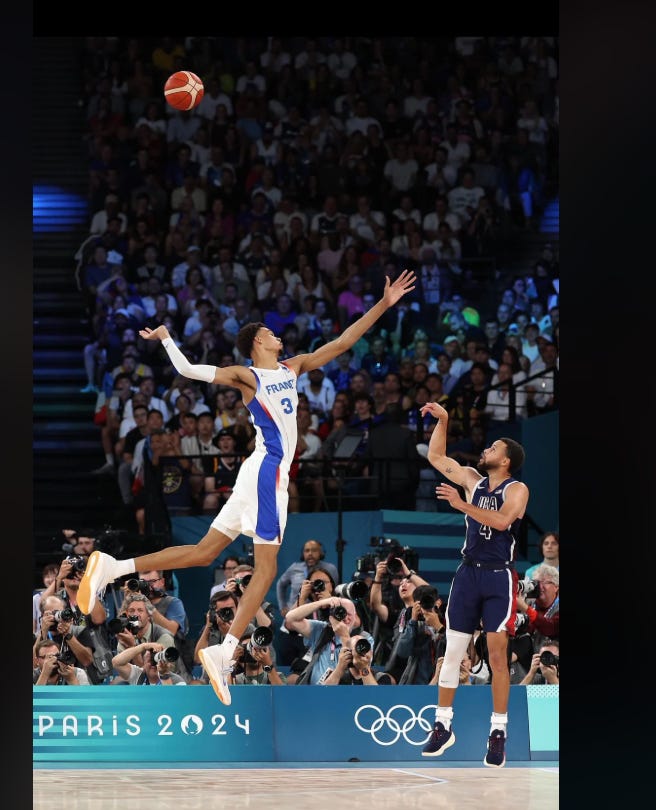
Steph Curry over Victor Wembenyama 2024 Olympics. Photographer: The photograph by Ezra Shaw of Getty Images.
Of course, all of these points can be applied to your business, your team, your products! With books, units sold would be akin to points per game. Rebounds might be an inverse of returns. Lower returns is better. Your FG % could be factored by the amounts in the market versus how many come back. If you place your product with good fits, it’ll show up in that percent.
Let me know examples you can think of in the comments! Thanks for reading.
The emotional affect seems to be what analysts call The Intangibles.