Efficiency Backlash
Learn to control chaos for breakthroughs

I had lunch with a friend last week. I said, “I think there is an efficiency backlash coming. I don’t know if it will be feasible in some ways but it’ll be lucrative for someone.” I’m picturing someone like Tim Ferris, author of The Four Hour Work Week or Mark Manson the author of The Subtle Art of Not Giving a F*ck. Maybe an SNL skit where someone loses it on AirTable and begs the camera for a simple spreadsheet with the essentials. I don’t mean like Paul Kingsnorth either. Something less analog purist and more sexy rebel. Maybe the concept of Friction Maxxing is a harbinger. From the BBC
While modern technology can streamline day-to-day life, making everything from dating to food delivery more efficient, it may come at a cost: early data suggests that our attention span may be shortening, critical thinking capabilities weakening, emotional intelligence fading, and spatial memory getting worse as we offload human tasks to our devices.
They told me “Don’t tell anyone in a hiring position that there is an efficiency backlash coming.”
Regardless, I think it’s an important thing to share for two reasons. Here’s my take. The first take is pretty short, the second one is longer.
The first one is the human concern. Talk of efficiency is really talk about man and machine or man versus machine. Man versus machine has been a roller coaster since John Henry. In our era,
Brene Brown, probably the most popular work life psychologist, built a brand on vulnerability but of late she talks about efficiency and burnout because when doing things faster is the goal the meaning gets lost.
“Our nervous systems aren’t ready for the level of uncertainty we are facing right now”
-Brene Brown
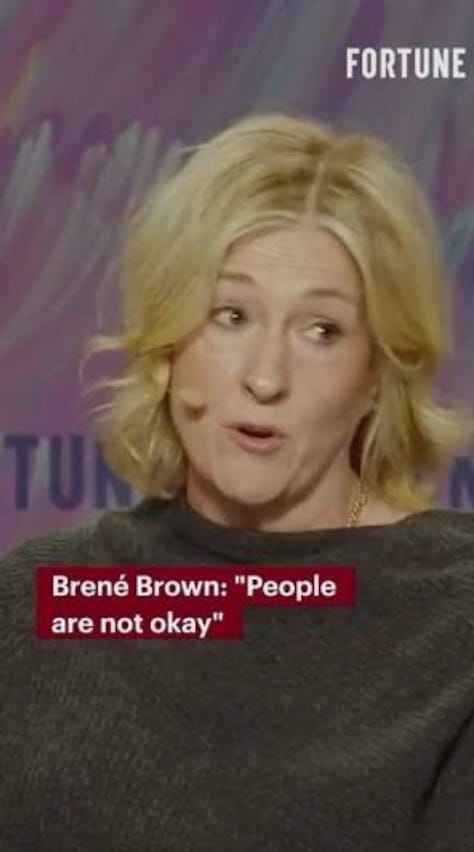
Brown, screenshot from Fortune event 2026
Studies suggest the loss of meaning leads to fatigue and burnout-which can undermine your effectiveness. These concerns alone cost a company a lot of coin. Now, Man AND machine? I’m typing this on a laptop and the benefits are supreme. It’s a win win.
I think what is getting missed is efficiency, and the constant drive to gain more takes you down a road that gets increasingly narrow. There is more than one way to skin a cat but eventually you are just reskinning the same poor cat and new process just to have new process ignores the trade offs and time spent in adoption. My gut is that if it’s not already happening there will be a lot of articles on this coming our way soon.

“Don’t Skin Me!” image from Substack / Unsplash
Now here is the reason that might really get the attention of the C suite.
Efficiency and unique products don’t always go hand in hand. Great products often take a circuitous route. Sometimes they are even developed to hide a perceived downside.
I need to interject right now. I am not advocating luddite inefficiency as a goal. I don’t think you need to spill gasoline all over the parking lot every time you fill up. I don’t think you need to have a meeting when an email will do. But there is something that inefficiency gives us that efficiency cannot.
To have creativity you have to have room for the unknown, or ambiguity.
The bold statement would be, you have to be ok with ambiguity to make something exceptional. Inefficient steps are the bread crumbs of innovation.
I saw an Instagram Reel by the Israeli Jazz Band Marbin last week. Dani Rabin, the band’s guitarist, asked the camera, aka the digital we, do you know why live rock died?
He answers, “It was optimized. Digital rigs, light sync, vocals in tune, auto patch changes, and it all became so boring..” Here is the link
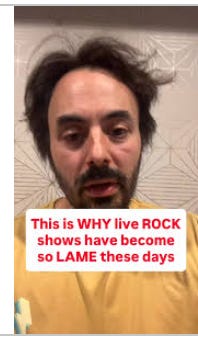
He goes on, “Big show live music is now boring and sterile because there are In Ears, Click Tracks, and Pre Set amps.” He sums it up, “We kept solving problems until there was barely a human left in the equation.” He adds, music was fun when no one knew what was going to happen. But now every risk has been eliminated. He implores us, “Don’t mistake precision for greatness.”
I would add, You cannot move people if there is no motion. Read that in your McConaughey voice.
Besides tech advancements, we live in a time with kids growing up with drum lessons, School of Rock, and a myriad of YouTube videos showing you every step from rig set up up to strumming patterns. A far cry from piecing together issues of Guitar World and playing a record over and over for the young of the 80’s.
I know some guys who play in bands like Dani mentions. And they would argue that the people coming to see these shows aren’t interested in organic or risky sounds, they want something to sound like the record. I think that’s true. Know your audience.
But what blew up the most on Social Media in the last 6 months?
Angine De Poitrine, a band that blends microtonal scales and crazy time signatures. Also they wear costumes. People are hungry for things that are out of the box. It’s certainly inefficient to paint your body in polka dots and wear a giant mask when you play but they now have a sold out tour.
I think there is something crucial Dani said, “We kept solving problems until there was barely a human left in the equation.”
Does that resonate with commercial creativity? Writing songs/ Writing books? Coming up with a new business idea? A new product line? You can certainly try to use data to tell you where lightning is going to strike but I asked ChatGpt what next band will break out like this and it gave me a list of bands similar to Angine. Maybe I need to work on my prompting.
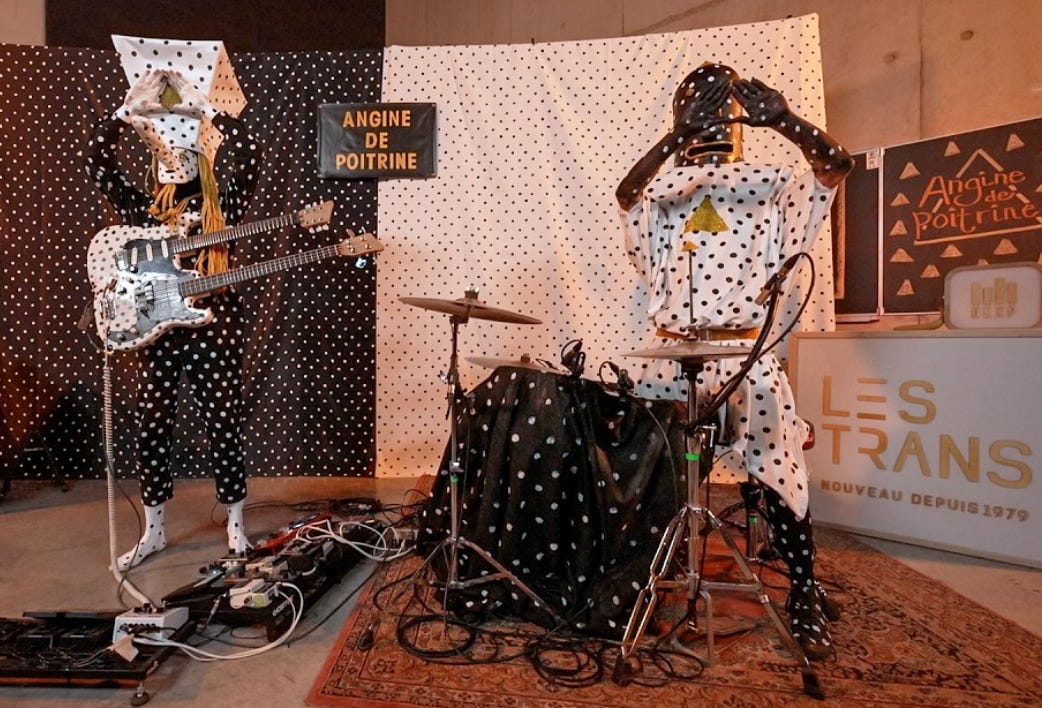
De Poitrine on WKXP-screenshot from YouTube Maybe bands are still leaning into making their limitations work for them. Tell me about ones you know in the comments.
Let’s talk about some examples of inefficiency and uncertainty being necessary to make something creative.
American Rock Band The White Stripes had two members, a husband and wife duo, guitar and drums, with a strange and mysterious intimacy. At the time they hit this was considered impossible but it became a norm due to a wide variety of reasons, all of them art and commerce lessons.
Can you imagine being a bass player in that band? You’d be a chemistry killer off the bat. And shoot, maybe it wasn’t that at all. It’s hard enough to get two people’s schedules to align, much less 3 or 4. Maybe they just needed an Outlook calendar. Ha ha.
This was where they executed efficiency. They didn’t bother with a 3rd person and To combat the lack of low end, Meg played her drums differently, relying on floor toms and keeping the beats simple and pulsating. Solid wham bam.
Did you watch the World Cup the last few weeks? If so, you’ve heard the song “Seven Nation Army.” It’s become a world wide sports stadium mainstay. It was prominently featured in the final halftime show care of The Muppets and New York Philharmonic and the Simón Bolívar Symphony Orchestra. When are The Muppets going to retire? They are ageless!
The song’s riff is an iconic bass beat down! But it’s not even a bass. Jack White, the guitarist, used an octave tool and a DigiTech Whammy pedal. He used the Octave Downsetting to give his guitar a deep vibe.
Why didn’t he just use a bass? Because a bass would feel and look totally different. It would take their show out of its groove. It would take them out of their vibe. Conversely, it was inefficient for his ability to play the guitar solos on the song. He can’t very well switch from a bass guitar to a six-string guitar mid-song, back and forth. He could use a looper? Wrong vibe. They could bring out a bass player for this song? Wrong vibe again.
The solution might seem inefficient but it’s working toward a greater creative efficiency. And in the end, a creation that resonated on a world wide scale.
Funnily enough, Jack White is not the only person from Detroit to be inefficiently creative. Perhaps it’s great poetry that Detroit is where Henry Ford brought blazing efficiency to the American workforce.

J Dilla was another Detroit artist that confounded efficiency. Hip hop in its roots is a creative work around. Young inner city artists couldn’t afford instruments but they could afford records, maybe even pilfering their parent’s stash.
Rap and Hip Hop were easily the major music from post grunge mid 90’s to mid 2010’s. Rhythm and the beat are crucial to hip hop. Of course, yes, great lyrics too. But the beat is essential. J Dilla played beats but J Dilla also played with time. He was like a time traveler in milliseconds. The advent of computer recording allowed users to visually see and map time onto a grid. Quantization. But Dilla turned off the feature and manually played his drum machines. With no effort he could get timing perfection but turning off the feature, he invented his own time signature.
Jordan Hall says “Believe it or not, we can thrive on imperfection if we let go of the reins.” in his Medium article on J Dilla. He goes on, “While this may seem necessary for keeping music in time, it can feel robotic in certain situations. Part of what makes music uniquely human is the little microscopic imperfections.”
Obviously, he and I would agree on our sensibilities. I’m just asking you to acknowledge that J Dilla made up a time signature that resulted in immense world wide influence by going down an inefficient route.
I should mention the excellent book, Dilla Time by Dan Charnas for my first exposure to these ideas. The book starts off with much verve and is a fun read, though my review would allow that it gets depressingly bogged down in the artist’s legacy.
I was getting a Cortado this morning.
The gal behind the bar asked, “Where is the matcha?”
The guy working the station with her pointed and jokingly said, “What do you take me for?” As in she didn’t trust he’d made it. He was doing it good naturedly. Fisticuffs were not in play. She declared, “Someone who is human and therefore makes mistakes!” Her tongue was in cheek but she was obviously reacting to many levels of trends in our current lives.
All in all? Preach sister.
I want my pilot to have a check list. I want my surgeon to wash his hands. I love a rain barrel. But, all humanity? All the time?
You might say, limitations or inefficiencies have no place in business.
Many of our largest companies in America are built on a mistake or a challenge.
I feel like I’ve heard these stories 100 times but the takeaway is they were instances where someone was trying to do one thing but by their mistakes or set back or inefficiency ended up being a breakthrough.
There are sort of a business greatest hits of oops. Charles Goodyear dropped a mixture on a stove and ended up making tire rubber. Post It Notes were considered a failed glue but they were perfect for non permanent adhesion. Silly Putty. On and on.

So, an efficiency backlash? Of course there is the uptick in analog record sales. Book stores are opening at a faster rate than in decades. Both purveyors of very inefficient ways of distributing goods. Journaling. Reading groups. Farm to table food. I think we are already doing it to be honest. But again, that’s not exactly what I am getting at. When I see it, I’ll let you know.
Let’s revisit Henry Ford for a minute. Henry Ford was probably dyslexic. I say probably because the diagnosis did not exist in his lifetime.Research shows 35% of entrepreneurs in the U.S. show signs of dyslexia. The very trait that makes reading harder often fuels the kind of nonlinear thinking behind breakthrough innovation.
But that tidbit is not what I want to show you. Ford famously said, “Any customer can have a car painted any colour that he wants so long as it is black” and this and other streamlining of choice made the car cheap and affordable. But then Ford’s popularity fell off because they did not offer variety. He said that in 1909 but by 1927 they took a 65 million dollar loss because they did not let go of some efficiency, only black I’m looking at you, for the sake of options aka colors.
It’s an odd time to create stuff when a computer can solve a math problem that is 70 years old or hack into another company. The news changes too fast to fathom But, some of us are going to have to be able to bridge the gaps, the spaces that are ambiguous, that are not clear wins. If you are still reading along I get the feeling you are with me.
Now, I’m going to be spending some time reading those inefficient books.

Thanks for reading!! Next week will be either on food, memory, and place or business books and making an experience. Still noodling. See how this works? Please subscribe!